Building a successful news website requires more than publishing articles and uploading images. News publishers need a reliable content management system (CMS), efficient editorial workflows, fast page loading, mobile-friendly layouts, and the flexibility to respond to changing audience expectations.
For many publishers, platforms such as WordPress provide everything needed to get started. Others may benefit from a headless CMS or a fully customized news publishing platform.
The challenge is deciding when an existing solution is sufficient and when investing in custom news website development makes more sense.
At W3Dezine, we understand that every website has different requirements. The right solution depends on your publishing goals, technical needs, budget, and plans for future growth.
In this guide, we explore the differences between ready-made CMS platforms and custom development, when each approach makes sense, and how to choose the right technology for your news website.
What Is Custom News Website Development?
Custom news website development involves designing and building a website around the specific publishing requirements of a news organization.
Instead of relying entirely on a pre-built theme or standard CMS configuration, developers can create customized layouts, editorial workflows, content structures, and integrations.
Depending on the project’s requirements, a custom solution may include:
- A tailored content management dashboard.
- Custom article layouts and content types.
- Editorial review and approval workflows.
- Breaking news and live-blogging functionality.
- Advanced search and content filtering.
- Author, category, and topic management.
- Subscription and membership functionality.
- Advertising management and placement controls.
- Integration with external news feeds and APIs.
- Performance optimization for growing audiences.
Not every news website needs these capabilities. A local news publisher may operate successfully with WordPress, while a large organization with specialized publishing requirements may need a more customized platform.
The objective is to select a solution that addresses real business needs without introducing unnecessary complexity.
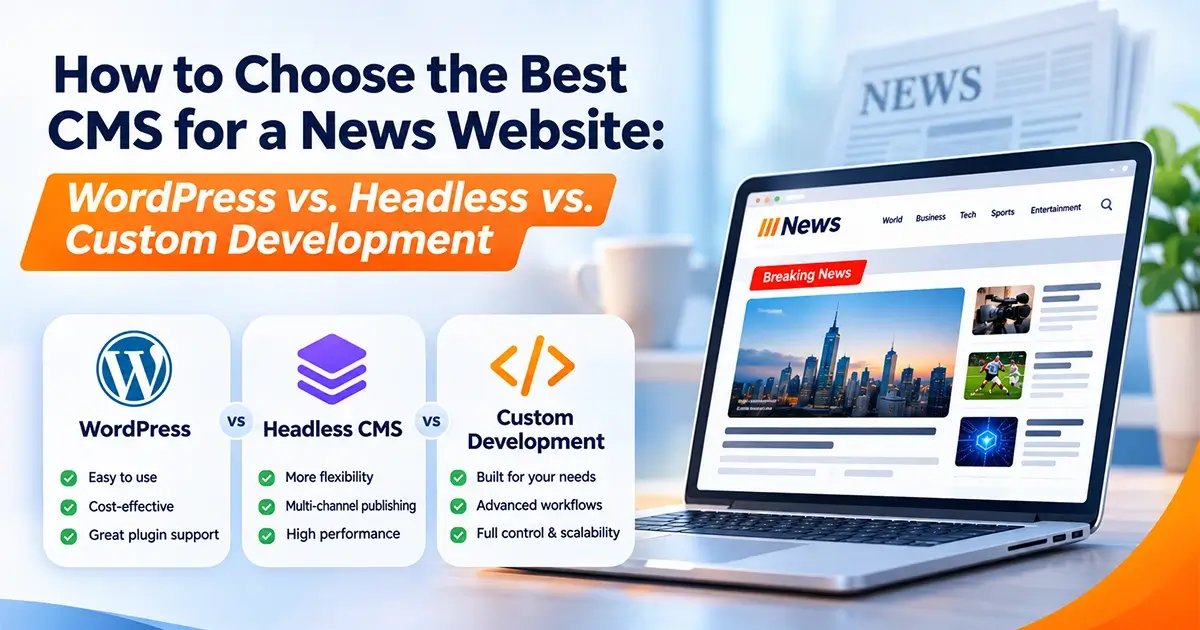
WordPress vs. Headless CMS vs. Custom Development
Before investing in a new platform, it is important to understand the available options.
1. WordPress: A Practical Starting Point
WordPress is a popular content management platform that enables publishers to create, edit, organize, and publish articles without developing a CMS from scratch.
Its themes, plugins, and customization options make it suitable for many types of news websites.
Key advantages:
- A familiar content management dashboard.
- Straightforward article publishing and scheduling.
- Flexible page layouts and responsive design.
- A broad selection of plugins and integrations.
- Support for author profiles, categories, and tags.
- Opportunities to improve SEO and website performance.
- Lower initial development complexity for standard requirements.
WordPress can also be customized with dedicated post types, custom fields, tailored templates, and purpose-built functionality.
When should you choose WordPress?
WordPress is often a good fit for local news websites, independent publishers, online magazines, industry publications, and smaller editorial teams.
If your primary requirements involve publishing articles, organizing content, displaying advertisements, and growing your audience, a properly configured WordPress website may be sufficient.
However, performance and maintainability require attention. Excessive plugins, poorly optimized themes, and unnecessary scripts can increase complexity and affect loading speed.
The solution is not automatically to abandon WordPress. A well-planned implementation and regular maintenance may address many of these issues.
2. Headless CMS: Separate Content Management From Presentation
A headless CMS separates the content management system from the website’s front end.
Editors manage articles and other content in the CMS, while a separately developed front end retrieves and displays that content through an API.
This architecture provides greater flexibility over how content is delivered across websites, applications, and other digital channels.
Key advantages:
- Greater control over front-end technology.
- Flexible content delivery across multiple platforms.
- Opportunities for advanced performance optimization.
- Structured content models for different publishing formats.
- Greater freedom to create specialized reader experiences.
When should you choose a headless CMS?
A headless approach may be suitable for publishers managing multiple digital properties, delivering content to websites and mobile applications, or requiring specialized front-end experiences.
It can also be valuable when the editorial system works well but the existing website presentation layer has become difficult to maintain or extend.
However, headless architecture introduces additional development and maintenance responsibilities. The front end, content APIs, hosting, previews, and publishing integrations must all work together.
For smaller publishers with straightforward requirements, this added complexity may not provide enough value to justify the investment.
3. Custom Development: Build Around Your Publishing Workflow
Custom development becomes relevant when existing platforms cannot efficiently support a publisher’s specific operational requirements.
Rather than adapting standard functionality to fit every process, developers can design a solution around the way the organization actually works.
Potential advantages:
- Editorial workflows tailored to the organization.
- Specialized user roles and permissions.
- Custom integrations with internal systems.
- Unique content structures and publishing tools.
- Greater control over platform architecture.
- Flexible implementation of specialized business rules.
When should you choose custom development?
Consider custom development when your publishing operation requires functionality that standard CMS platforms cannot provide efficiently through reasonable configuration or extensions.
For example, a publisher may need a multi-stage approval process involving reporters, section editors, legal reviewers, and administrators.
Another organization may require specialized data visualizations, real-time content updates, complex subscription rules, or integration with proprietary databases.
In these situations, a customized platform may provide a more suitable long-term solution.
However, custom development typically requires a larger initial investment, more planning, and ongoing technical support. Security, backups, scalability, and future upgrades must be included in the development strategy.
Custom development is most valuable when its benefits justify these additional responsibilities.
When Should You Build a Custom News Website?
A custom platform should solve identifiable problems rather than simply offer a different technology stack.
Here are six situations in which building a customized solution may be worth considering.
1. Your Editorial Workflow Is Too Complex
A growing newsroom may involve multiple writers, editors, fact-checkers, and administrators.
If articles must pass through several approval stages before publication, a basic publishing workflow may become difficult to manage.
A custom solution can support requirements such as:
- Role-based access permissions.
- Multiple editorial approval stages.
- Scheduled and embargoed publication.
- Revision tracking and editorial history.
- Notifications for pending reviews.
- Automated content assignment and routing.
Before building from scratch, assess whether an existing CMS and suitable extensions can meet these requirements. Custom development is most appropriate when those options create significant limitations.
2. Your Website Needs Specialized Features
Standard publishing features are generally available through established CMS platforms.
However, some news organizations need more specialized functionality.
Examples include:
- Real-time sports scores and statistics.
- Live event reporting and continuously updated stories.
- Interactive maps and data-driven journalism.
- Specialized research databases.
- Custom subscription and access rules.
- Personalized content experiences.
- Integration with proprietary reporting systems.
If these features are central to your publishing model, a custom application or a hybrid CMS architecture may be worth evaluating.
3. Performance Is a Business Priority
Readers expect news websites to load quickly, particularly on mobile devices.
Slow pages can frustrate visitors, reduce engagement, and make it harder for readers to access breaking news.
Performance problems do not automatically mean you need custom development. Image optimization, caching, a content delivery network (CDN), efficient code, and appropriate hosting can improve an existing website.
However, if your current architecture consistently struggles to meet your performance requirements, a redesigned front end or more substantial architectural changes may be appropriate.
Evaluate the actual bottlenecks before choosing a solution.
4. Your Publishing Operation Is Expanding
A website that works well for a small editorial team may become more difficult to manage as content volume, staff, and audience expectations increase.
A growing publisher might need:
- Multiple editorial departments.
- Additional content types.
- More advanced search and filtering.
- Centralized management of several publications.
- Different permissions for different teams.
- Integrations with advertising and analytics systems.
Custom development can help organize these requirements into a coherent platform.
Nevertheless, growth alone does not justify a complete rebuild. The decision should depend on whether the existing CMS can continue to support the organization’s needs.
5. You Need Greater Integration Flexibility
News organizations often rely on multiple tools for publishing, newsletters, subscriptions, advertising, analytics, and customer relationship management.
If these systems do not communicate effectively, employees may spend time transferring information manually.
A customized integration layer can help connect existing tools and automate repetitive processes.
For example, publishing an article could trigger a newsletter workflow, update a content distribution system, or send structured information to another internal platform.
The right approach may be a custom integration rather than an entirely new CMS.
6. Your Existing Platform Has Become Difficult to Maintain
A website may accumulate outdated plugins, overlapping functionality, inconsistent templates, and complicated workarounds over time.
This can make updates risky and new features expensive to implement.
Before replacing the entire platform, conduct a technical audit.
The audit should identify:
- Existing functionality that must be retained.
- Performance and security concerns.
- Unnecessary plugins and extensions.
- Content migration requirements.
- Integration dependencies.
- Opportunities for targeted improvements.
Sometimes a redesign or structured WordPress redevelopment is sufficient. In other cases, migrating to a different architecture may be the more sustainable choice.
When Should You Buy Instead of Build?
Custom development is not always the best investment.
For many publishers, an established CMS offers a faster and more economical path to launch.
Consider an existing platform when:
- You need to launch your news website quickly.
- Your publishing workflow is relatively standard.
- Your team has a limited development budget.
- You do not require specialized application features.
- Your editorial team needs a familiar dashboard.
- Existing themes and plugins meet your requirements.
For example, a local news publication with a small editorial team may only need article publishing, categories, author profiles, advertisements, search, and newsletter integration.
WordPress can provide these capabilities without the expense of developing an entirely new content management system.
The important principle is simple: choose technology based on the problem you need to solve, not on the assumption that a more complex solution is automatically better.
Cost Comparison: Existing CMS vs. Custom Development
The cost of a news website depends on its functionality, design, content volume, integrations, hosting requirements, and ongoing maintenance.
A useful comparison should consider both initial development costs and the expenses associated with operating the platform over time.
| Cost Factor | WordPress | Headless CMS | Custom Development |
|---|---|---|---|
| Initial development | Often lower for standard websites | Moderate to high, depending on the front end | Usually higher |
| Design flexibility | High with appropriate customization | High | Can be tailored to specific requirements |
| Specialized functionality | Plugins and custom development | APIs and custom front-end features | Built around defined requirements |
| Editorial workflow | Suitable for many standard workflows | Depends on the CMS and integrations | Can be designed around the newsroom |
| Technical maintenance | CMS, theme, plugin, and hosting maintenance | CMS, front-end, API, and hosting maintenance | Ongoing maintenance of the custom application |
| Time to launch | Often faster | Requires front-end development | Typically requires more planning and development |
| Long-term cost | Depends on customization and maintenance | Depends on infrastructure and development needs | Depends on complexity, support, and future changes |
These are general comparisons, not fixed pricing estimates. Actual costs vary significantly from one project to another.
Look Beyond the Initial Development Cost
A realistic budget should account for more than the website build.
Consider:
- Design and development.
- Hosting and infrastructure.
- Domain and software subscriptions.
- Security monitoring and backups.
- Updates and technical maintenance.
- Content migration.
- Staff training.
- Future enhancements and integrations.
An inexpensive initial build can become costly if it requires frequent repairs or extensive workarounds.
Similarly, a custom platform can become expensive if its architecture is unnecessarily complicated or its maintenance requirements are underestimated.
The goal is to find the best balance between initial investment, operational efficiency, and long-term flexibility.
SEO and Performance Considerations for News Websites
Search visibility is an important consideration when selecting a news website CMS.
A well-designed platform should help search engines discover, crawl, and understand published content while providing a positive reading experience.
Regardless of the technology you choose, prioritize the following areas.
Search-Friendly Website Structure
Organize articles into logical categories and create clear navigation between related topics.
Use descriptive URLs, appropriate internal links, and accessible author and category pages where relevant.
Page Speed and Core Web Vitals
Optimize images, reduce unnecessary scripts, configure caching, and monitor page performance.
Core Web Vitals can help you assess important aspects of loading performance, responsiveness, and visual stability.
Structured Data
Where appropriate, implement relevant structured data, such as Article or NewsArticle, according to Google’s documentation and eligibility requirements.
Structured data can help search engines interpret page content, but it does not guarantee enhanced search results.
Mobile-Friendly Reading Experience
News audiences frequently access content on mobile devices.
Make sure article text is readable, navigation is intuitive, advertisements do not overwhelm the content, and important page elements work correctly on smaller screens.
Content Organization and Discoverability
Provide clear article headlines, meaningful metadata, relevant categories, and useful internal links.
For publishers seeking visibility in Google News, also review the applicable content policies and technical guidance.
A custom CMS does not automatically provide better SEO than WordPress. Results depend on implementation, content quality, technical configuration, and ongoing optimization.
How to Choose the Right Development Approach
Before committing to a platform, work through these five steps.
Step 1: Define Your Publishing Requirements
Document the features your organization needs today and those it expects to require in the future.
Separate essential features from optional improvements.
Step 2: Evaluate Your Existing Platform
If you already have a website, identify its current limitations.
Determine whether the problems can be resolved through configuration, optimization, redesign, or targeted development.
Step 3: Compare Available Solutions
Evaluate WordPress, headless CMS options, and custom development against your actual requirements.
Consider editorial usability, performance, integration needs, security, maintenance, and cost.
Step 4: Plan for Content Migration and Growth
If you are replacing an existing platform, prepare a migration plan for articles, images, authors, categories, URLs, metadata, and redirects.
Protecting existing content and search visibility should be part of the project from the beginning.
Step 5: Build Only What You Need
Choose the simplest architecture that meets your requirements reliably.
Start with essential functionality, establish a clear development roadmap, and add advanced capabilities when there is a demonstrated business need.
This approach helps control complexity while leaving room for future improvements.
Why Choose W3Dezine for News Website Development?
At W3Dezine, we focus on building websites that combine practical functionality, thoughtful design, and reliable performance.
Whether you are launching a new publication, redesigning an existing news portal, or improving a WordPress website, the development approach should reflect your business goals.
Our website development services can support projects involving:
- WordPress website design and development.
- Custom page layouts and responsive interfaces.
- CMS customization and content management.
- Website speed and performance optimization.
- SEO-friendly website structures.
- Third-party integrations and functionality enhancements.
- Website redesign and ongoing improvements.
We believe the best solution is not necessarily the one with the most technology. It is the one that helps your team publish efficiently, serve readers effectively, and maintain the website with confidence.
If WordPress meets your needs, we can help you make the most of it. If your requirements call for a more customized approach, we can help assess the options and plan an appropriate solution.
Final Thoughts
Choosing between WordPress, a headless CMS, and custom development is ultimately a business decision.
WordPress is often an excellent choice for publishers that need a practical, manageable content platform. A headless CMS can provide greater flexibility for specialized content delivery and front-end experiences. Custom development becomes valuable when unique workflows, integrations, or application requirements justify the additional investment.
Before building a news website from scratch, identify the limitations you need to overcome and evaluate the alternatives carefully.
The best news website is not the one with the most complicated technology. It is the one that supports your editorial team, delivers a reliable experience to readers, and gives your publication room to grow.
Ready to Improve Your News Website?
Whether you need a new WordPress website, a CMS redesign, or help evaluating custom functionality, W3Dezine can help you identify a practical way forward.
Contact W3Dezine to discuss your website requirements and explore a solution tailored to your publishing goals.